It's still dark on the Seine. — Your first sentence of the day, and of the language.
Scroll · the day begins
Private French · the South of France · 10+ years
★★★★★28 reviews·4.8 average · 10+ years · native French
Most courses start with je m'appelle. Nobody here has ever begun a conversation that way.
They start with the hour. What you say at six in the morning to the one other person awake is not what you say at seven in the evening with four people talking over each other — and no textbook has ever explained the difference, because textbooks aren't organised by time of day. Life is.
So this page is a day in Paris — the France you pictured before you ever came. I teach from the South of France, which is the same language at a slightly slower pace. Seven moments, seven things you'd actually say. Scroll through it and you'll have heard a whole day of French in context — which is roughly how the first lesson goes too.
One to oneOnline, worldwide30 · 45 · 60 minA1 → B2
Credited against your first package · Complete beginners very welcome
Meet Your New French Teacher | Learn French with MickaelWatch on YouTube
08 h — La boulangerie
Deux baguettes, s'il vous plaît.
Two baguettes, please. — The first sentence anyone actually needs.
Your first words happen standing at a counter
Complete beginners start with the twenty or so sentences a day in France actually requires — ordering, counting change, being asked a question you did not expect. Thirty minutes twice a week, from A1, with no French at all required to begin. There is nothing to catch up on first.
Not in a grammar table. Ordering, counting change, being teased about your accent, and carrying on anyway — which is the actual skill, and no app teaches it because no app can make you slightly uncomfortable in a queue.
Complete beginners are my favourite students. Thirty minutes, twice a week — an hour of a brand-new language is more than any head can hold. By the fourth lesson you order without rehearsing it first, and that's the moment people decide they can do this.
Is that any good? — Three words. You'll use them for the rest of your life.
Then you learn to argue about tomatoes
Past the first sentences, the useful French is the French of ordinary disagreement — preferring one thing to another and saying why. That is where vocabulary stops being a list and starts being opinions, and it is the point at which most people begin to enjoy it.
Food is half of French culture and most of its adjectives. What's good this week, what isn't, and why the man at the next stall is wrong about all of it. Nobody is being polite here and that is exactly why it's the best classroom in the city.
At the bakeryOrdering, counting, small talk that goes somewhereA1 · A2
Sunday at the marketThe vocabulary of taste — and of disagreeingA2 · B1
Just talkingYou understand more than you can say. We fix thatAny level
Can you say that again? — The most useful sentence in the language, and the hardest to ask without embarrassment.
The afternoon is for the real work
There are two courses, split by level rather than by price. Débutant is A1 to A2, thirty minutes twice a week. Intermédiaire is B1 to B2, a full hour, because the plateau is speed and register rather than vocabulary. The hourly rate is identical either way — the format is a teaching decision, not a pricing one.
Almost everyone who writes to me is somewhere between the first word and comfortable — A1 to B2. So there are two courses. Not two price tiers: the same hour, pointed at two completely different problems.
A1 to B2 is not my own scale. It is the Common European Framework of Reference for Languages, published by the
Council of Europe, which defines six levels from A1 to C2 and is what every language
certificate in Europe is measured against — the DELF included. A1 is being able to handle
simple, concrete exchanges; B2 is following an argument at normal speed and holding your side
of it. Above B2, someone else will serve you better than I will.
For scale: the Organisation internationale de la Francophonie counted 396 million French
speakers in its March 2026 report, which makes French the fourth most spoken language in
the world after English, Mandarin and Spanish — and nearly two thirds of those speakers are in
Africa rather than in Europe. The French on this page is the one spoken in France, because
that is the one I have; it is understood everywhere on that list.
Which one are you?
Your courseA1 → A2
Débutant
Beginner — from nothing at all
You have never said a word of French, or you did five years of it at school and kept bonjour. We start from where you actually are, which is usually further back than people like to admit. It's my favourite place to begin: nothing has gone wrong yet, and everything you learn gets used the same week.
Order, ask, and understand the answer
Get through a shop, a café, a ticket office
Talk about yesterday, not only about today
Hear where one word ends and the next begins
30 minutes, twice a week.An hour of a language you don't have yet is exhausting. Two short lessons beat one long one — same hourly rate, twice as often, and you forget less in between.
You are understood. You still translate in your head, you lose the thread the moment three people talk at once, and films need subtitles. That is the plateau, and it is not a vocabulary problem — it is speed and register.
Follow French at the speed it is actually spoken
Hold your side of a disagreement
Move between vous and tu without thinking
Watch a film instead of reading one
60 minutes, once or twice a week.A scene from Truffaut played three times — once to be lost, once with the text, once without. A Brel lyric taken apart line by line.
Both start with as much English as you need, and less of it every month. Whatever you are aiming at sits on top of them:
Cinema & chansonReal French at real speed, with all the shortcutsB1 · B2
DELF preparationThe exam has a shape; knowing it is most of passingA1 → B2
Business FrenchMeetings, email, the register that gets you taken seriouslyB1 +
Book a first lesson — €20Not sure which one you're on? Book the first lesson and we'll find out in ten minutes.
17 h — La terrasse
On se tutoie ?
Shall we drop the formal 'you'? — The moment a conversation becomes a friendship. There is no English for it.
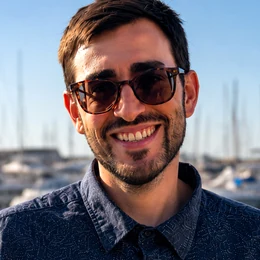
Bonjour — I'm Mickael
I am a French teacher from Cannes, in the South of France, with ten years of private lessons behind me, and I teach in French and in English. Twenty-eight students have written a review, averaging 4.8 out of 5. Lessons are one to one and online, anywhere in the world, A1 to B2.
I teach from the South of France, and I've taught French privately for over ten years, to dozens of students of every nationality. Twenty-eight of my students have written a review, averaging 4.8 out of 5, and you can read every one of them.
I don't teach the French of textbooks. I teach the French you'd hear on this terrace on a Friday — fast, full of swallowed syllables, and much friendlier than it looks written down. The gap between those two languages is the entire reason people plateau, and closing it is most of what I do.
The most important thing to know before you start: the gap between textbook French and spoken French is not vocabulary — it is speed and register. You can know a word perfectly and still miss it at conversational pace, or use it correctly in the wrong room. Both are fixable, and neither is fixed by learning more words.
Meet me — €20You will know inside ten minutes whether this works for you.
19 h — Au zinc
Santé !
Cheers. — Say it looking them in the eye, or it doesn't count.
This is the hour everyone is learning for
Twenty-eight students have written a review across several platforms, averaging 4.8 out of 5 over more than ten years. The three below are their own words, and the other twenty-five are here.
Four people talking over each other, nobody slowing down for you, and you keeping up anyway. It's closer than it feels — and it is what students notice first.
“I’ve been taking French lessons with Mickael for the past 8 weeks, and I’ve really enjoyed learning with him. He is patient, encouraging, and always takes the time to explain things clearly. He has helped me a lot with my French and given me more confidence to speak. I highly recommend him!”
Maria
“It feels like I have only just started learning French, but I can already have simple conversations and ask questions in different situations… ask a waiter in a Parisian bistro about Beef Bourguignon, or ask someone on the street how to get to the Louvre.”
Lidia
“Prepared tutor who tailors the lesson to your level and to your goals. Pleasant to talk to… That's why I booked further lessons after the first.”
Edoardo
“Very patient, and takes time to explain minor grammar details, which I truly appreciate.”
See you tomorrow. — Which is, in the end, the only thing a language is for.
Tomorrow starts with one lesson
An hour costs €60, VAT included, with no platform taking a third of it. A first lesson is thirty minutes for €20, credited against a package if you carry on. Five hours is €270 and ten is €510. Nothing renews and there is no account to create.
Thirty minutes, at a time that suits you, wherever in the world you are. If it clicks — and you'll know inside ten minutes — you'll get a code by email afterwards, with a thank you, for your first package.
What you just learned, without noticing
06 hIl fait encore nuit sur la Seine. — It's still dark on the Seine.
08 hDeux baguettes, s'il vous plaît. — Two baguettes, please.
11 hC'est bon, ça ? — Is that any good?
14 hTu peux répéter, s'il te plaît ? — Can you say that again?
17 hOn se tutoie ? — Shall we drop the formal 'you'?
19 hSanté ! — Cheers.
22 hÀ demain. — See you tomorrow.
One rate for both courses and every subject. Pick the length that suits the level — thirty minutes is the beginner's format, sixty is where the intermediate work happens.
€3030 minutes
€4545 minutes
€6060 minutes
Package
30 min
45 min
60 min
Single lesson
€30
€45
€60
Five lessons−10%
€135€27 each
€202€40.40 each
€270€54 each
Ten lessons−15%
€255€25.50 each
€382€38.20 each
€510€51 each
Prices are final — VAT included, nothing added at checkout, no platform commission.
Your first lesson is thirty minutes for €20.
Short and cheap on purpose, and credited against your first package. That is the entire commitment — no subscription, no membership, nothing that renews. If it isn't for you, that is simply where it ends.
Pick your hourChoose a slot from my calendar, shown in your own time zone. I teach from France every day, 7am to 9pm French time
2
Pay for that half hour€20 by card, once. Nothing renews, and there is no account to create.
3
We meet — and you keep the codeA Google Meet link arrives by email — nothing to install, it opens in your browser — and a shared Google Doc that stays yours. Afterwards, a thank you and a single-use code for your first package, good for a week.
Before you book
What if I'm between the two courses?
Most people are. Book the first lesson and we'll know inside ten minutes — nothing is locked, and you can move between the two whenever it makes sense.
Do you teach in English?
Yes — as much as you need at the start, and less of it every month. I'm C2 in English. I speak Italian and basic Russian too, but I teach in French and English.
Do I need to buy a textbook?
No. Everything comes from real material — a film scene, a song, a conversation at a market stall. What we cover is written into a shared Google Doc as we go, so every correction, note and piece of homework stays in one place you can reopen whenever you like. You need a connection and nothing else.
What if I have to cancel or move a lesson?
Move it or cancel it up to 24 hours before it starts, and it costs you nothing. Inside 24 hours the lesson is due — with the exception you would expect: if you are ill, or something genuinely outside your control happens, we move it and that is the end of it. I am not going to charge you for having flu.
How often should I have a lesson?
Beginners: thirty minutes, twice a week — an hour of a brand-new language is more than any head can hold. Intermediate: a full hour, once or twice a week.
Is €60 really the final price?
Yes. €60 an hour, VAT included, and no platform taking a third of it. What you see is what you pay.
★★★★★28 reviews·4.8 out of 5, over more than ten years
I teach 7am to 9pm Paris time, seven days a week —
6am to 8pm in London,
and early morning to mid-afternoon on the US east coast, so French before work is
easy from New York and an evening lesson is not.
Book a lesson
One to one, online. A first lesson is €20 for
thirty minutes — short and cheap on purpose, because deciding whether someone suits you
should not cost much. Times are shown in your own time zone.
No hour that suits you?
Tell me when you could do it and I will write the moment one opens up — people cancel
more often than you would think. Nothing is booked and nothing is charged.
1 · What are you booking
How long is each lesson
How many
A package books its first lesson now — that is its start date. The rest we
arrange between us as you go, and the whole package is paid for today.